 Admin
Admin
By Rev. Andre Serhalawan
Nothing is crueler than a strategy that comes with a peaceful face. Nothing is sneakier than an approach that offers money but steals the future. In a corner of South Papua, right in Ngguti District, Merauke, a human drama is playing out. The story is classic. The script is old. But it still works the same: divide, control, and abandon.
This is De Vide et Impera!!!
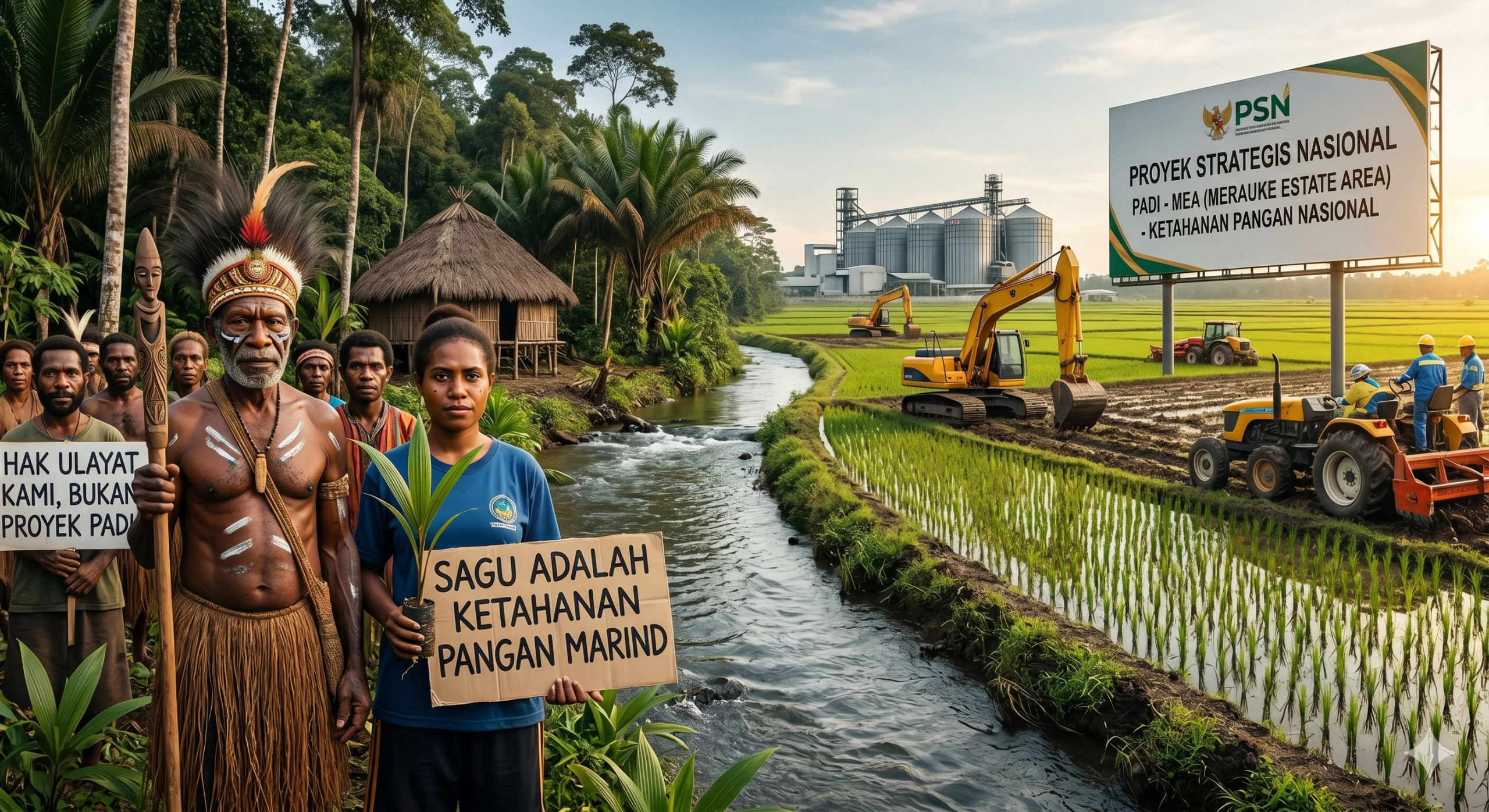
If you only read government reports, this area is just a development corridor—asphalt roads that will shorten distances, speed up logistics, and strengthen food security. But for Esau Kamuyen and the customary rights holders of the Kamuyend clan, this land isn’t a dead map. It’s breath. It’s an ancestral archive. It’s the last remaining page of a nearly torn customary book.
But in the face of the National Strategic Project, the land no longer speaks the language of custom. It’s translated into hectares, compensation figures, and signature columns. And when the language of custom is no longer understood, the old strategy returns.
De Vide et Impera, though often spoken as a popular spin-off of the classic Latin phrase Divide et Impera, has its own unique meaning in today’s colonial power plays. If Divide et Impera literally means “split and rule,” then De Vide et Impera emphasizes something more subtle: emptying out meaning before taking over space.
Breaking it down, De Vide can mean “about emptiness” or “to make empty.”
In practice, this approach works in three layers:
First, Symbolic Dehumanization. Customary land is no longer seen as sacred space that records collective history. It’s emptied of spiritual value, then refilled with exchange value. Sago forests that have given life for thousands of years are reduced to “idle land” that needs to be “awakened” by capital. Phrases like “Papua is not empty land” actually appear because the state and corporations have treated Papua as empty space from the start—ready to print, ready to cut, and ready to crush.
Second, Social Fragmentation. De Vide et Impera doesn’t start with open violence. It often borrows the hands of your own relatives. In the Merauke PSN case, this pattern is clear: clans willing to give up land become the “entry point,” then are positioned against clans still holding out. As anthropologist Laksmi Savitri put it, companies “creatively” map customary structures, find the gaps, and turn horizontal conflict into a brutal negotiation tool.
Third, Disarticulation of Customary Leadership. In this strategy, traditional elders don’t need to be killed. Just disabled. Not with weapons, but with compensation. Not with prison, but with soft loans. When an Ondoafi or clan head starts receiving “gift money,” their voice slowly weakens. They are no longer a fortress but a bridge for corporate interests.
This is where De Vide et Impera shows its efficiency. Blood doesn’t spill, because blood is replaced with money. Enemies aren’t fought, because enemies become partners. Resistance isn’t crushed, because resistance is broken from within.
The night of January 24, 2026, Esau Kamuyen will never forget. That night, the land he had always stood on with confidence—passed down through generations—suddenly turned into a field of hostility. It wasn’t soldiers who came. It wasn’t police who surrounded him. What came were faces he knew: people from Nakias and Yodom villages. Neighbors. Same tribe.
“They’re not enemies,” Esau said later. “But that night, they were used.”
The attack nearly killed him, but it destroyed Esau Kamuyen’s heart. Bows, arrows, machetes, and spears rained down on his house. Other clans who once sat together with him on the customary mat had already backed away. One by one, they let go of their customary rights. One by one, the traditional elders were disabled—not by bullets, but by promises of compensation that were never equal to the value of the land taken.
After that, Esau fled. Not because he was afraid to die, but because he realized: dying on your own land without resistance is the quietest betrayal. He chose to join Yawimu village, one of the few villages still standing firm to defend their inheritance. There, he wasn’t looking for protection. He was looking for collective strength.
The big question people often ask: Why are indigenous communities so easily divided? Why can’t they see through this strategy? The answer isn’t stupidity. The answer is structural blindness—systematically created.
When someone has lived under economic pressure for generations, an offer of tens or hundreds of millions in cash isn’t just a temptation; it’s the cry of an empty stomach finally being answered. Companies and project owners understand this. They calculate the breaking point of each clan. They offer “gift money” not as fair compensation but as a silencing tool.
According to Komnas HAM records, indigenous communities were never involved in the planning process. They’re only presented with a choice: agree or not, even though maps of production forests and concessions were issued long ago without confirming customary boundaries. And when Vincen Kwipalo from the Kwipalo clan—one of the few voices consistently refusing—filed a case with the Constitutional Court, he was criminalized based on a company’s report. Not the company being investigated for land grabbing, but the landowner being called by police. This is De Vide et Impera in its most perfect form: not just dividing the community, but flipping the positions of victim and perpetrator.
Ngguti District, Merauke, isn’t just a name on an administrative map. This is where the customary rights of the Kamuyend clan spread. This is also where the PSN is building roads and bridges that will cut through traditional forest. The impact is already being felt. The conflict is no longer vertical between communities and corporations. It has shifted into horizontal conflict: between clans, between villages, even between families. In Nakias, Esau Kamuyen was driven out by those who once sat with him at the same table in traditional rituals.
Komnas HAM’s report states that the right to security for South Papua’s indigenous communities has been violated. The presence of thousands of military personnel and dozens of security posts has actually created psychological terror, not protection. But when it’s your own relatives acting as executioners, security forces stay silent. When houses are attacked and arrows fly, no help comes. The state only shows up in the form of concession certificates and ministerial decrees.
The MRP of South Papua Province must not remain a spectator. According to Law No. 2 of 2021, recognition of customary rights is a constitutional mandate—non-negotiable. Merauke District Regulation No. 5 of 2013 even explicitly recognizes the Malind Anim community’s customary rights over the area from Kondo Village to the Digoel River, which includes Ngguti District.
The South Papua Parliament must act immediately. FGDs on public peace and order in Boven Digoel and Mappi in November 2025 discussed the importance of community protection. But talk without action is hypocrisy. The draft regulation on community protection must be implemented now—as real intervention in Ngguti. Not to secure the project, but to save the people.
The PGI MPL assembly in Merauke, January 30-February 2, 2026, produced a firm declaration: The Church rejects the PSN, rejects militarism, and supports Papua’s indigenous communities. But a declaration must become action, not just an archive. The GPI Papua Synod, as the mother church for congregations in Nakias, Salamepe, Tagaepe, and surrounding areas, is being tested. Will the church choose silence to maintain “neutrality”? Or will the church show up—as a mother embracing her wounded children?
Remember the closing reflection of the PGI MPL service from GPI Papua Synod Secretary, Pastor B.A. Leiwier, M.Th: “True peace isn’t just the absence of conflict, but the presence of justice.” If the church allows its people to be pitted against each other, if the church stays silent when customary land is taken, then the church has lost its reason for being. Go down. Calm them. Save the people.
Remember!
Esau Kamuyen is not alone. He stands with Vincen Kwipalo, who planted a red cross on his customary land as a sign: “This land is not for sale.” He stands with the youth of Yawimu who refuse to be divided. He stands with the Malind mamas who say, “Food that grows freely on free land—that taste is freedom.”
De Vide et Impera might be effective. It might have disabled many clans. It might have silenced many elders. But in Yawimu village, some are still holding on. As long as there is one clan refusing to be turned against another, as long as there is one piece of land left unsigned, as long as there is one family choosing to run toward the battleground of resistance—this classic strategy will never fully win. Those who stand today are the last trench. Don’t let them fall alone. Greetings.
God bless and keep us all. Amen.